Cluster-Trial Recruitment Bias: When the Clinic Knows the Assignment Before the Patient Enters
Anas H. Alzahrani, MD PhD MPH
Department of Preventive Medicine and Public Health
Faculty of Medicine, King Abdulaziz University
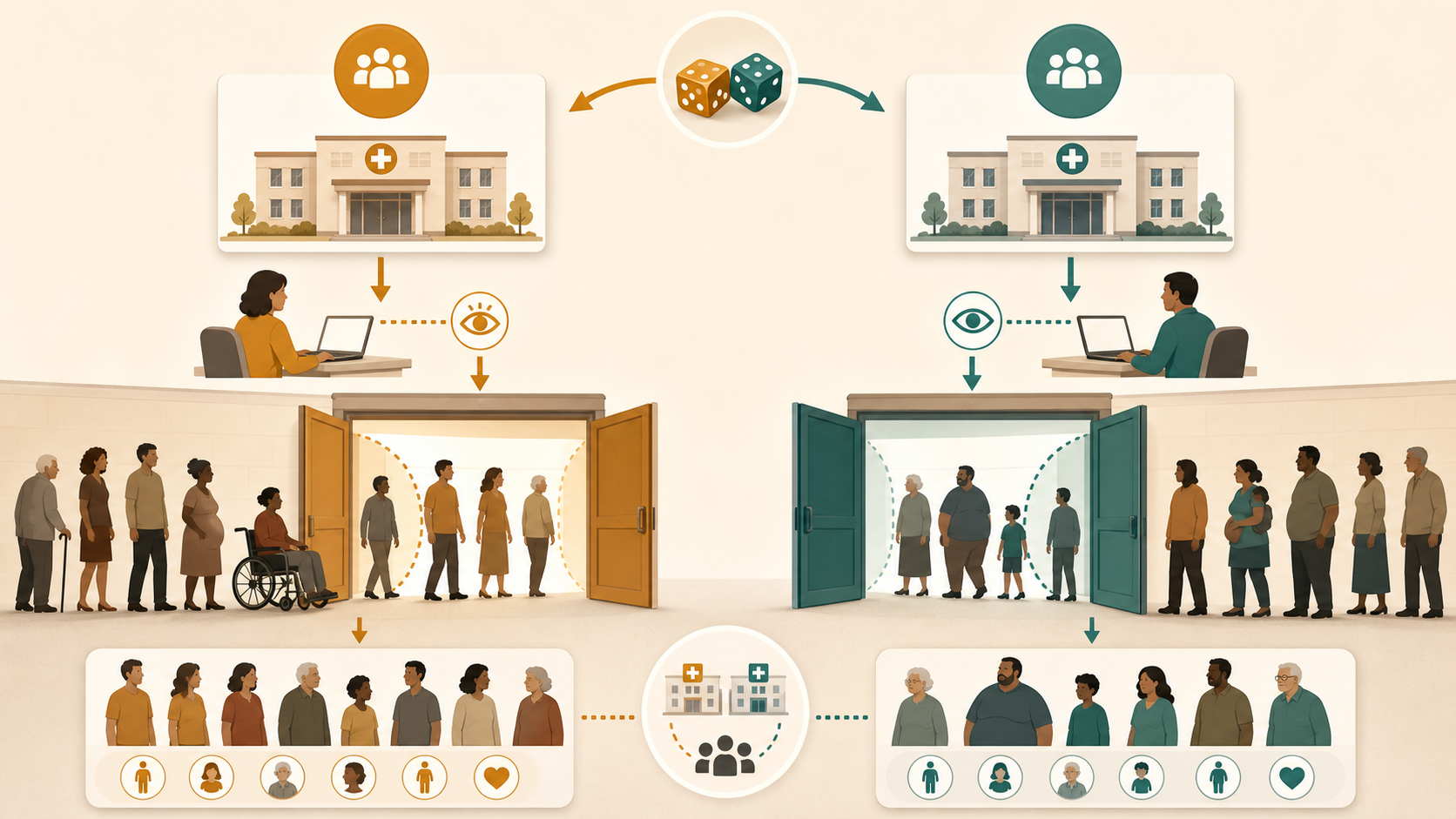
A cluster-randomized trial assigns hospitals, practices, wards, schools, or communities rather than individual patients. That design can be exactly right when an intervention operates at the group level or would spill across people. But it creates a timing problem that ordinary trial language can hide: the clinic may learn its assignment before the patients who will contribute outcomes have been identified.
If assignment knowledge changes who is noticed, approached, enrolled, or willing to participate, the patient groups are no longer formed only by chance. The clinics were randomized. The analyzed people may have been selected afterward.
The Trial Has Two Entry Doors
Cluster trials operate at two levels. Clusters enter and receive an assignment; individuals then enter those clusters as participants or analytic records. A credible paper must preserve and report both flows. Accounting for intracluster correlation protects the standard error from pretending that patients within one clinic are independent. It does not repair a patient sample whose composition changed because the clinic already knew what it would deliver.
Cluster-level protection
Random assignment supports comparison of the clinics or groups that were allocated.
Individual-level vulnerability
Later recruitment can condition inclusion on assignment, prognosis, preferences, or care pathways.
This is why recruitment bias is not merely an external-validity concern. Differential selection can change the prognosis of patients compared across arms and therefore distort the estimated treatment effect itself.
Draw the Chronology Before Reading the Effect
- 1. Define clusters. Which hospitals, practices, or communities could enter?
- 2. Randomize clusters. When was the assignment revealed, and to whom?
- 3. Identify eligible people. Was there a fixed list, a complete database query, or clinician judgment?
- 4. Invite and consent. Could recruiters or patients respond differently to the known intervention?
- 5. Measure outcomes. Which clusters and people actually contributed to the estimate?
The dangerous sequence is assignment first, discretionary identification second. A recruiter who knows that one clinic offers an appealing new service may search harder, describe participation differently, or approach patients with a different prognosis. A patient may also accept or decline based on the known treatment. In routinely collected data, no invitation is required: the intervention itself may change diagnosis, coding, testing, or the electronic marker used to define eligibility.
Four Ways the Patient Mix Can Move
| Stage | How assignment can act | What to inspect |
|---|---|---|
| Identification | Clinicians recognize or code more eligible cases in one arm | Stable algorithm, source population, screening log |
| Invitation | Recruiters approach patients selectively or with different enthusiasm | Recruiter masking, scripted invitation, approached denominator |
| Consent | Known treatment changes willingness to participate | Timing of consent, refusal counts and reasons by arm |
| Analysis inclusion | Post-assignment data availability determines who counts | Outcome-specific cluster and patient denominators |
Design Safeguards Are Stronger Than Statistical Rescue
The cleanest safeguard is to identify and, when appropriate, recruit individuals before cluster assignment. When that is infeasible, investigators can use a complete enumeration of eligible people under an objective rule, keep recruiters unaware of assignment, separate care delivery from recruitment, standardize invitation materials, and record everyone screened, approached, enrolled, and analyzed.
The frozen-door test
Ask whether exactly the same people would have crossed the recruitment door if their clinic had received the other assignment. If the answer could change, the trial needs a prevention strategy and a cautious estimand—not only a clustered regression model.
Covariate adjustment or weighting may reduce bias when the variables that drive differential recruitment are measured well and modeled appropriately. Those methods cannot guarantee recovery of an effect for people whose selection depended on unrecorded prognosis, clinician judgment, or treatment preference. Adjustment can support a sensitivity analysis; it should not be narrated as if it re-randomized the recruited sample.
What Population Does the Estimate Describe?
A cluster trial can target several populations: every eligible person in randomized clusters, people who would be recruited regardless of assignment, or the people actually recruited under each assigned strategy. These are not interchangeable. Post-randomization recruitment can make the observed sample partly an effect of the intervention itself.
The paper should state the target population, show how eligibility was operationalized in each arm, and explain whether inclusion is a pre-existing property or a downstream event. If the analysis only supports an effect among a selected recruited population under strong assumptions, the abstract should not silently promote it to all eligible patients.
A Reviewer Checklist
- Were individual participants identified before or after clusters were randomized?
- Who could see the cluster assignment while screening, inviting, or consenting participants?
- Did the intervention change how eligible patients were recognized in routine data or clinical practice?
- Were eligibility rules objective, stable across arms, and applied to a complete enumeration of each cluster?
- Do recruitment counts, reasons for nonparticipation, and baseline characteristics differ by arm?
- What population does the reported effect describe: all eligible people, all approached people, or only those recruited?
Baseline tables are clues, not certificates. Visible arm differences can reveal selection, but similar measured characteristics cannot exclude selection on unmeasured severity, motivation, or clinical judgment. Read the recruitment mechanism before treating balance as reassurance.
What Not to Conclude
- “The analysis accounted for clustering, so the design is valid.” Correlation and selection are different problems.
- “The clinics were randomized, so patient covariates can only differ by chance.” That is false when patients enter after assignment through a discretionary process.
- “Recruitment rates were similar.” Equal quantities can conceal different kinds of participants.
- “Adjustment removed the bias.” That claim requires measured selection drivers, a defensible model, overlap, and a clearly stated target population.
Sources and Evidence Maturity
- Hemming et al., “Covariate adjustment in cluster randomised trials: a practical guide” (24 October 2025) — peer-reviewed methods guidance; mature synthesis with explicit limits on adjustment.
- “Role of recruitment bias in stepped-wedge cluster randomised controlled trials: a systematic review” (2025) — peer-reviewed systematic review; contemporary empirical maturity.
- Hemming et al., “Key considerations for designing, conducting and analysing a cluster randomized trial” (2023) — peer-reviewed practical methods review; mature design guidance.
- Eldridge, Kerry, and Torgerson, “Bias in identifying and recruiting participants in cluster randomised trials” (9 October 2009) — peer-reviewed methodological guidance; longstanding conceptual evidence.
- CONSORT extension to cluster randomised trials (2004) — official reporting standard; mature consensus guidance on allocation, recruitment, and two-level flow.
The Practical Bottom Line
In a cluster trial, ask two randomization questions: what was assigned, and who entered after the assignment became visible? The first tells you where chance operated. The second tells you whether chance still governs the people being compared.
Randomized clinics do not automatically create randomized patients. Freeze the recruitment door before allocation when possible; when it stays open, show exactly who controlled it, who crossed it, and how that changes the claim.
Where Aqrab Fits
Aqrab helps reviewers turn a cluster-trial label into an auditable sequence: cluster eligibility, assignment, participant identification, consent, follow-up, and analysis. Try Aqrab on a cluster-trial manuscript, or explore the developer documentation for structured review workflows.
Keep reading
Don't stop at one method.
Good methods judgment comes from contrast. Read the neighboring guides, see where the assumptions diverge, and avoid treating every observational problem like it needs the same hammer.
Hierarchical Testing in Clinical Trials: When a Significant Secondary Endpoint Is Still Descriptive
A practical hierarchical testing guide for clinical researchers. Reconstruct the prespecified testing path before treating a small p-value on a secondary endpoint as confirmatory evidence.
Randomized Withdrawal Trials: Why a Relapse-Prevention Win Is Not a New-Patient Effect
A practical randomized withdrawal trial guide for clinical researchers. Audit the run-in, responder enrichment, withdrawal contrast, safety, and target population before generalizing a maintenance-effect claim.
Allocation Concealment: The Randomized-Trial Safeguard That Works Before Assignment
A practical allocation concealment guide for clinical researchers and peer reviewers. Separate sequence generation, concealment, implementation, and blinding before trusting the word randomized.