Front-Door Criterion: The Causal Backdoor Alternative Nobody Uses Enough
Most causal inference teaching spends its time on the backdoor path: identify confounders, adjust for them, pray you measured the right variables, then argue about residual bias in the discussion. The front-door criterion is different. It says that even when treatment and outcome are confounded, you can still identify the causal effect if you fully observe the mechanism linking treatment to outcome and a very particular set of assumptions holds. That sounds magical. It is not magical. It is just rare, demanding, and easy to misuse.
The front-door criterion matters because it forces a stronger style of causal thinking. Instead of asking, “what covariates should I throw into regression,” it asks, “do I understand the mechanism well enough to identify the effect through it?” That is a much better question, and in most observational studies, the honest answer is no.
The Core Idea
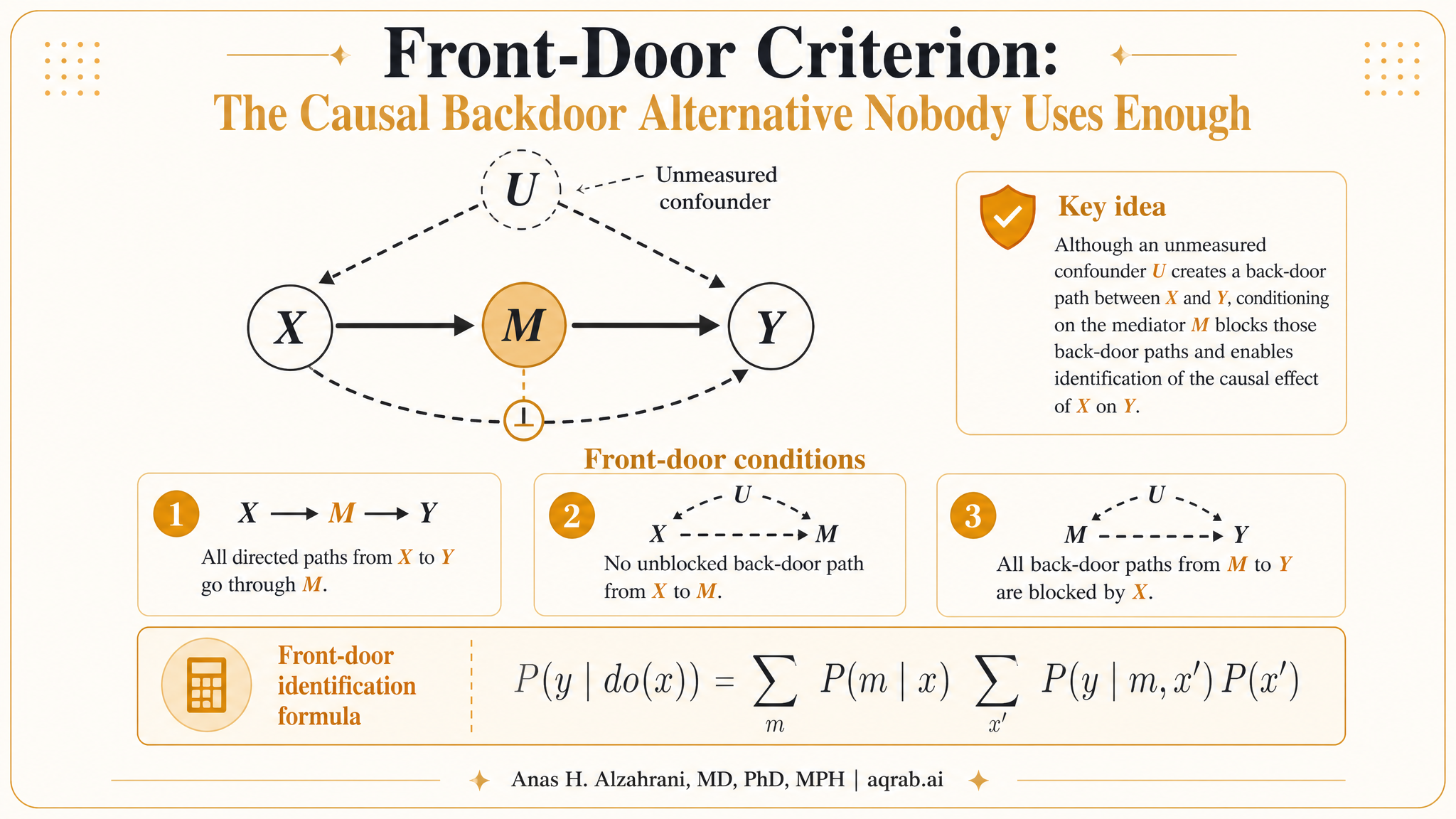
Imagine an exposure A, an outcome Y, and a mediator M. There is unmeasured confounding between A and Y, so standard adjustment fails. The front-door strategy uses the mediator to recover the causal effect anyway.
The intuition:
- 1. Treatment changes the mediator.
- 2. The mediator changes the outcome.
- 3. Once you condition on treatment, there is no unblocked backdoor path from mediator to outcome.
- 4. The treatment affects the outcome only through that mediator.
If all of that is true, then the mediator becomes a bridge that carries identifiable causal information from treatment to outcome, even though treatment and outcome themselves are confounded.
The Three Front-Door Conditions
Pearl's front-door criterion requires more than “there is a mediator.” It needs three specific conditions.
1. The mediator intercepts all directed paths from treatment to outcome
There cannot be a remaining direct effect of treatment on outcome outside the mediator pathway you are measuring. If treatment also affects outcome through another route, the front-door formula breaks.
2. There is no unmeasured confounding of treatment and mediator
You must be able to estimate the causal effect of treatment on the mediator. If hidden factors affect both treatment assignment and the mediator, the bridge is already cracked.
3. All backdoor paths from mediator to outcome are blocked by treatment
After conditioning on treatment, there must be no unmeasured mediator-outcome confounding. This is the part people usually wave away, and it is where most applied front-door fantasies die.
Why This Is Harder Than Backdoor Adjustment
Front-door identification sounds like a clever workaround for unmeasured confounding, but in practice it demands a cleaner mechanistic story than most real datasets can support. Backdoor adjustment asks whether you measured enough confounders. Front-door asks whether you measured the entire causal channeland whether that channel is itself free of hidden bias. That is a brutal standard.
Hard truth:
A variable is not a front-door mediator just because it sits in the middle of your DAG drawing. It has to carry the full causal mechanism you care about, and you need a believable argument that its own links are not confounded.
A Clinical Example That Almost Works
Suppose you want the causal effect of a text-message adherence program on blood pressure control. Program uptake is confounded because more motivated patients are more likely to enroll. That motivation is not fully measured. If the program's only effect on blood pressure operates through medication adherence, and you measure adherence well, then adherence might serve as a front-door mediator.
But now the real questions start. Is adherence measured without serious error? Could motivation affect adherence directly even after conditioning on program uptake? Could the text messages also improve diet, clinic attendance, or home monitoring, creating treatment-to-outcome paths outside adherence? If yes, the front-door claim collapses.
That is why true front-door opportunities are uncommon. You need a nearly complete mechanism, not a vague intermediate variable.
The DAG Logic
The clean front-door DAG usually looks like this: an unmeasured variable U confounds treatmentA and outcome Y, treatment causes mediator M, mediator causes outcome, and there is no direct arrow from treatment to outcome once the mediator is included.
Conceptually:
- U → A and U → Y create unmeasured confounding.
- A → M is identified.
- M → Y is identified once you condition on A.
- There is no remaining direct path A → Y.
That final line is the killer assumption. If treatment affects outcome through multiple mechanisms, and you only measured one of them, you do not have a front-door design. You have an incomplete mediation story.
How the Identification Works
The front-door formula decomposes the effect into two causal pieces: first the effect of treatment on the mediator, then the effect of the mediator on the outcome. It effectively rebuilds the treatment effect by averaging over how treatment shifts the mediator distribution and how those mediator values change outcome.
You do not need to memorize the algebra to use the idea correctly, but you do need to understand what the formula is borrowing from the data. It is estimating:
- how much treatment changes the mediator, and
- how much the mediator changes the outcome within levels of treatment.
If either part is biased, the whole estimate is biased. Front-door is not a loophole around causal logic. It is causal logic with more demanding inputs.
What Usually Breaks in Applied Studies
Partial mediation pretending to be full mediation
The treatment has multiple pathways, but the paper measures one convenient mediator and acts like it is the whole story.
Mediator measurement error
If the mediator is noisy or crudely proxied, you are not observing the mechanism cleanly enough for front-door identification.
Mediator-outcome confounding
Severity, motivation, access, clinician behavior, and surveillance can confound the mediator-outcome link even after conditioning on treatment.
Time ordering mistakes
If treatment, mediator, and outcome are not clearly ordered in time, the DAG story is already suspect.
When Front-Door Is Actually Worth Considering
I would only take a front-door design seriously when four things are true. First, the mechanism is narrow and scientifically plausible. Second, the mediator is measured well, not as a lazy proxy. Third, a direct treatment effect outside the mediator is genuinely hard to argue for. Fourth, the paper shows the DAG and defends the mediator-outcome confounding assumptions explicitly.
Settings with tightly engineered interventions sometimes come closest, especially when the intervention was designed to change one process and that process was directly observed. In contrast, broad behavioral, policy, and health-system exposures usually fail because they act through too many channels at once.
Front-Door vs Mediation Analysis
These are related, but not interchangeable. Mediation analysis asks how much of a treatment effect runs through a mediator. Front-door identification uses a mediator to identify the total causal effect itself despite unmeasured treatment-outcome confounding. That is a much stronger claim.
| Question | Mediation analysis | Front-door criterion |
|---|---|---|
| Main goal | Decompose effects into pathways | Identify the total treatment effect |
| Unmeasured A-Y confounding allowed? | Usually no | Yes, under strict front-door assumptions |
| Need full mediation? | No | Yes |
What Reviewers Should Ask
- What evidence supports the claim that the mediator captures all directed treatment effects?
- Why is there no serious unmeasured confounding of treatment and mediator?
- Why are mediator-outcome backdoor paths blocked after conditioning on treatment?
- Is the mediator measured precisely enough to represent the mechanism?
- Does the timeline actually support the DAG?
If a paper cannot answer those questions clearly, it should not be advertising a front-door design. At best, it has a mechanistic hypothesis. At worst, it has causal cosplay.
The Practical Bottom Line
The front-door criterion is one of the most beautiful ideas in causal inference because it proves that confounding is not always fatal if mechanism is observed well enough. But beauty is not permission to use it carelessly. Most applied front-door opportunities are fake, mostly because the mediator is incomplete, noisy, or confounded.
Still, the method is worth learning. Even when you never use the formula, front-door thinking improves your study design instincts. It forces you to ask whether you understand the mechanism, whether your mediator is real, and whether your causal story survives contact with time ordering and measurement. That alone makes it more useful than half the regressions in the literature.
Keep reading
Don't stop at one method.
Good methods judgment comes from contrast. Read the neighboring guides, see where the assumptions diverge, and avoid treating every observational problem like it needs the same hammer.
Overadjustment Bias: When More Covariates Make Causal Inference Worse
A practical guide to overadjustment bias for clinical researchers. Covers mediators, colliders, post-treatment variables, propensity score misuse, and why the biggest adjustment set is often the least credible one.
DAG Construction: How to Draw a Causal Graph Before You Touch the Model
A practical guide to DAG construction for clinical researchers. Covers time ordering, node selection, confounders vs mediators vs colliders, minimally sufficient adjustment sets, and why most covariate lists are just causal confusion wearing a regression badge.
Structural Causal Models & DAGs: A Practical Guide for Clinical Researchers
The causal framework behind every method you use. Covers DAGs, d-separation, do-calculus, backdoor/frontdoor criteria, mediation analysis, and how to draw the graph that makes your analysis work.